Tag: meditate

  • Connecting > Materialistics: How To Determine Your Value

    Connecting > Materialistics: How To Determine Your Value

    It’s All About The Ego

    Investing in the few connections that mean the most to you outweighs any materialistic thing. 

    That lesson took awhile for me to fully comprehend because my Ego was so programmed to have the most expensive things, live in the biggest home and drive the fanciest vehicle. 

    My Ego tricked me into believing that my worth was dependent upon other’s opinions of me and I was focusing on perspectives that were unsatisfying leaving me feeling empty. 

    Man, Is That All Wrong

    Once I let go of materialistic things and focused more on self love and nurturing the connections that meant most to me, I began to see the world in a different light.

    • You start to value your time more. 
    • You start giving attention to the people and ideas that matter to you.
    • You start to cherish the moments you have with yourself and those most valuable to you.
    • You start to question everything. 
    • You start allowing those people and things to exit your life to make room for what is meant for you.
    • You start to learn who you truly are and what your purpose is while here. 
    • You start to see the signs and synchronicities that align with your truth.
    • You start focusing on making yourself joyful, not just happy. 
    • You start making decisions that are fulfilling.
    • You start building confidence and self worth.

    Question Everything

    The Christians believed if you ask then you shall receive. God, the Universe, your Highest Self, whatever you believe in, also aligns with this fact. When you start to question your ways of thinking and doing, it allows room for curiosity and openness. This allows your source to speak to you and teach you what you’re meant to learn on this journey. 

    Something Is Here For You To Learn

    So if this read came into your reality, then maybe there’s a message here for you. I encourage you to ask, listen and feel what your intuition tells you.

    white background with elegant black writing that says love and light kristin with a heart attached to the n in kristin
  • The Art of Saying “No”

    The Art of Saying “No”

    It Stems From People Pleasing Energy

    Recovered people pleaser over here to tell you the secret that will propel your healing to become abundant in confidence, self worth and attract what’s meant for you.

    Well, based on the title, it’s not a secret anymore although if I knew it was the answer to why I felt so drained and experienced inner turmoil, I would have utilized it much sooner. 

    People pleasers are those who always say yes, even to thoughts and actions that don’t align with their truth.

    Why Is It So Hard To Say “No”?

    That’s because they don’t know their truth. 

    Chances are they grew up in a home where one or more of their caregivers were unpredictable which caused their homeostasis to remain in fight or flight mode. They had to constantly shift their behavior to satisfy their caregiver(s) which didn’t give them an opportunity to discover themselves. 

    Fast forward to adult years and you will see someone who is mentally, emotionally, spiritually, and physically drained because they spend their time doing for others versus doing for themselves. 

    It’s Time To Be A Healthy Selfish

    In order to discover who you are and what your purpose is while on this journey, one has to become a healthy selfish. 

    A healthy selfish includes preserving one’s energy for what’s valuable to them, not others, and that starts with saying “no”.

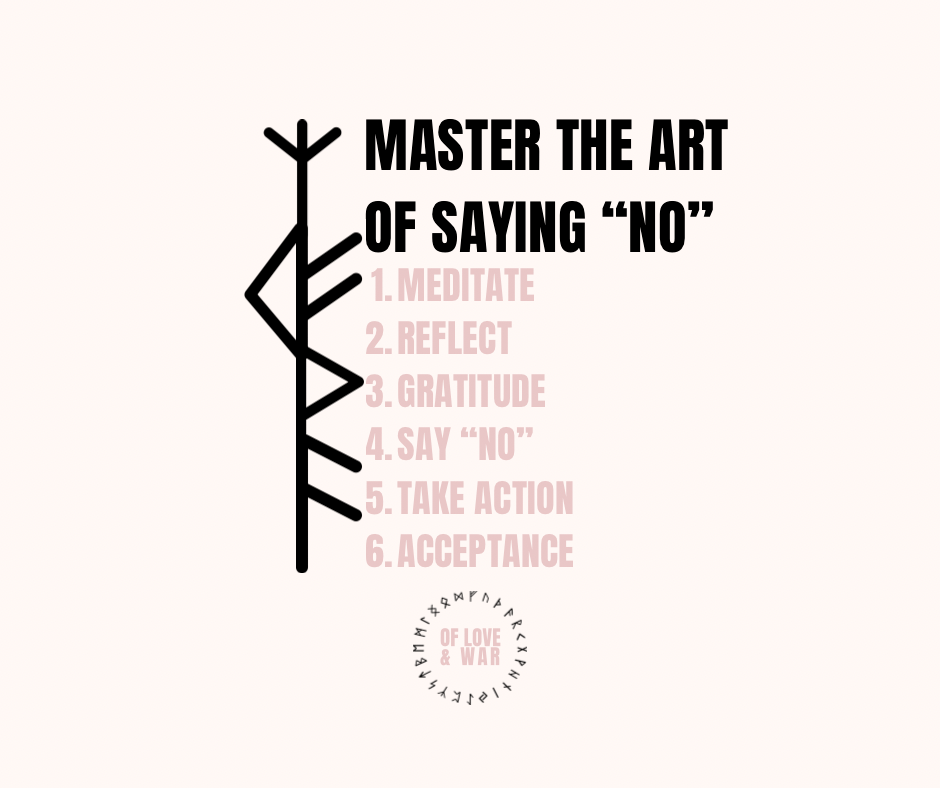
    Here Are Some Ideas To Learn The Art Of “No”:

    1. Meditate. If you’re new to meditating, start with spending 5 minutes per day. For mediation tips, check out my article (insert link here)
    2. Reflect. You have to know what you don’t want to know what you do want. Journal your thoughts on aspects of your life you don’t like and follow up with what changes you want to see. Be specific. This step will show you what you feel is valuable to you.
    3. Gratitude. For every situation, choose something to be thankful for. It’s so easy to think a low vibrational or negative thought and ride the flow, however if you set the intention to recognize the good, it will become easier to be grateful.
    4. Say “no”. It’s going to be very uncomfortable at first, however start using the word “no” in response to thoughts or actions you don’t feel are valuable to you and push past that uncomfortable feeling because it will pass.
    5. Take action. Find a hobby. Go explore. Take that sip n paint class you’ve been eyeballing. Do something! Start spending your time doing things you feel are valuable instead of spending your time doing things other’s find valuable. 
    6. Acceptance. Be easy on yourself. Know that this is a learning process and it’s going to be uncomfortable at first however the more you say “no” the more you’ll discover who you are as a person and what your truth is.
    Mastering the art of saying “No” is so liberating!

    Keep Going, It Gets Easier

    These 6 steps are continual tasks. The more time you spend focusing on the art of saying “no” the more you will notice you begin to trust yourself and learn your truth of who you really are. The more you trust yourself, the more confident you will become which also build your self worth.

    It’s going to be some work at first and your life will look like it’s crumbling, however you have to clear out the people and situations that aren’t meant for you in order to make room for what is. 

    After a while, saying “no” will be easy because you have confidence, know your worth, and know who you are and you won’t sacrifice any of that for anyone else. 

    Keep shinning!

  • The Benefits of Being Present in Daily Life

    The Benefits of Being Present in Daily Life

    Distractions are everywhere.

    How do you make time for yourself, your goals, and your people?

    Join me as I discuss the value of being present and tips you can implement starting today.

    What Does It Mean To Be Present?

    Present is being aware of the here and now.

    Fully appreciating the magnificent ability to observe our thoughts, sights, sounds, tastes, and feelings; in the 3D and above.

    It’s also understanding we are more than this 3D body. We are spiritual beings walking this Earth to learn lessons in order to ascend and heal our souls.

    Benefits Of Being Present

    Being present has so many benefits. They include:

    • Anti-anxiety
    • Improved Sleep
    • Better Mood
    • Anti-depressive
    • Reduction in PTSD symptoms
    • Improved Self Image
    • Appreciation for life
    • Overall Better Health
    • Better Life Choices

    This is not an exhaustive list of the benefits to being present and everyone has their own experiences.

    [Please consult your doctor before making any life changes.]

    Being Present And Time

    The benefits of being present offer one a new appreciation for their life and choices.

    In return, this offers a new perspective on how and who one spends their time.

    One begins to understand that how one spends their time is the most valuable.

    Thoughts are careful created, conversations are selectively chosen, actions are premeditated and direction with intention becomes clearer.

    Being present offers one the ability to master their life in a way their soul intended.

    How To Be Present

    The first way to be present is through grounding techniques, then one can add daily meditation.

    Grounding is when one uses their senses to bring their mind back to the present. It’s a way to silence the thoughts and reduce the energetic noise.

    There are many different grounding techniques one can use to be present.

    I recommend starting with a 3D sense of your choice to start: sight, sound, taste, touch, and smell.

    You can ask yourself about each sense. This will bring you back to the present moment.

    This takes practice and gets easier.

    You’ll also find which sense resonates with you.

    For tips on how to meditate check out my blog How To Meditate: Tips For Mindfulness and Focus.

    Let’s chat! What sense did you chose? How does it work for you?

    Leave a comment

  • How to Meditate: Tips for Mindfulness and Focus

    How to Meditate: Tips for Mindfulness and Focus

    What Is Mediation?

    If you’re new to meditation or want some new ideas, then this article is for you!

    Meditating is the art of silencing one’s mind in order to rest it. It also provides opportunities for growth and healing.

    Meditation Benefits

    The benefits of meditating are limitless although here are some to take note of:

    • Reduces racing thoughts by quieting the mind
    • Improves mental stamina and focus
    • Better sleep, nutrition, and overall health
    • Builds confidence and self worth
    • Breaks one free from the subconscious programming
    • Understands how to be present

    Physical training : physical bodies = meditation : minds.

    Be Patient With Yourself

    Know that the time it takes to experience the benefits of meditating are unique to each individual, so one may experience benefits within a month or two, while another may benefit after several months. For me, it took 2 weeks.

    There is one key idea one needs to be aware of that seems to be a pattern among those that begin meditating: it can be overwhelming at first.

    Think of a dog that’s been in its kennel all day and has some pent up energy. When you take that dog outside, it’s so excited to let all that energy out it pulls on the leash or runs around excitedly. Your mind is like that dog. It has so many thoughts pent up and needs a release, so you have to commit to stick with it and have faith you will feel peace one day.

    How To Meditate

    This is what I suggest:

    Set your intention to meditate for 5 minutes and tell yourself “I am going to meditate for 5 minutes. My mind does not defy me and I am not what my thoughts say I am”.

    Start with 5 minutes per day. Set a timer on your phone or watch. You can increase the time to 10 minutes after you start to feel more comfortable. And eventually 30 minutes or more.

    Sit in a place that you won’t be disturbed.

    Relax and close your eyes.

    Focus on deep breaths in your nose and out your mouth, counts of 4 each. (Once you’re comfortable, you can inhale and exhale using your nose, however exhaling out of your mouth also releases negative energy.)

    For example: long slow inhale in nose count 1, 2, 3, 4 then long exhale out of mouth count 1, 2, 3, 4.

    Continue focusing on your breaths.

    Allow your mind to think freely. Let it think, say, picture whatever it wants while you continue to breathe.

    Detach from what your mind is saying. Allow it to flow away from you. For some, they picture the words and pictures flying into the sky away from them. Detach however you feel works best for you.

    Keep going and flow through those 5 minutes.

    Be Comfortable Getting Uncomfortable

    It’s going to be uncomfortable, yet it gets better after continued practice. Getting uncomfortable is the only way to grow.

    Let me know how it went! Do you meditate regularly and feel you can offer some insight for those who are new to meditating? Let’s connect!

    P.S. Let me know if you want to learn more!